How to Tell Your Sump Pump's Battery Backup Has Already Failed
What a battery backup actually does, why it tends to fail without warning, and how to check yours before the next power outage does.
September 17, 2026 · 3 min read
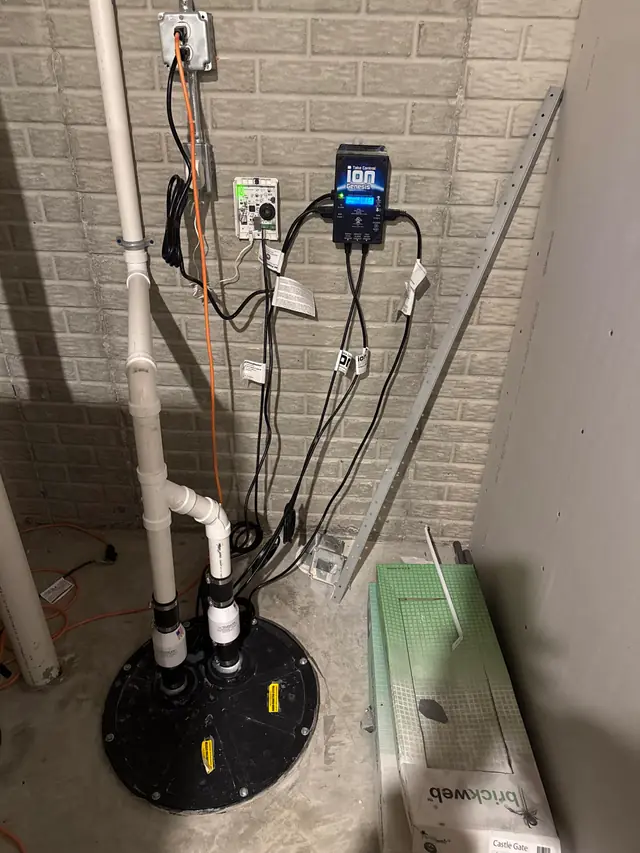
A sump pump earns its keep in the two or three storms a year that actually test it, and most of the time nobody thinks about it between one storm and the next. The pump itself usually keeps working. What quietly stops working is the battery backup sitting next to it, and that is the part that matters most, because it is the only thing standing between your basement and a flooded floor the moment the power goes out.
Two Pumps Doing Two Different Jobs
The primary sump pump runs on house current. A float switch rises with the water level in the pit, trips the switch, and the pump pushes water out through the discharge line and a check valve, away from the foundation. That works fine as long as the power stays on. The battery backup is a second, smaller pump wired to its own battery, sitting dormant until either the power fails or the primary pump cannot keep up with the water coming in. Heavy rain and power outages tend to arrive together in Southeast Wisconsin, which is exactly the situation the backup exists for.
When both pumps are working, a basement can ride out a multi day power outage without taking on a drop of water. When the backup has quietly died, the exact same outage leaves nothing running to catch what the primary pump would have handled, and by the time anyone notices, there can be several inches of water across a finished basement floor.
Why the Backup Fails Without Warning
A battery that sits in a basement corner for a couple of years, occasionally trickle charged, degrades in a way that gives almost no outward sign. It can hold enough charge to light an indicator lamp long after it no longer has the capacity to run a pump for more than a few minutes. Corrosion builds on the terminals slowly. The float switch on the backup pump can seize from sitting still between uses. None of that shows up unless someone actually tests the system, which is exactly what most homeowners never get around to doing until the power goes out during a storm and the basement fills anyway.
Signs the Backup Has Already Failed
- The battery's charge indicator light is off, dim, or blinking in a pattern you have never checked the manual for.
- You cannot remember the last time you tested it. If it has been longer than a year, treat that as a sign on its own.
- There is visible corrosion or a white crust on the battery terminals.
- The unit's alarm does not sound when you press the test button.
- The battery is several years old and has never once been replaced.
Testing It Yourself
You can check the system without waiting for a storm. Unplug the primary pump from the wall outlet so the backup is the only thing running, then pour a few buckets of water into the sump pit. The backup pump should kick on, cycle the water out, and the alarm should sound to let you know it is running on battery power. If it hesitates, runs weak, or does not start at all, the battery or the backup pump itself needs attention before you need it for real.
What a Professional Inspection Adds Beyond the Bucket Test
The bucket test tells you whether the backup runs at all. It does not tell you how much runtime is actually left in a battery that is showing its age, whether the check valve on the discharge line is holding, or whether corrosion on a wiring connection is about to become a bigger problem. A plumber checking the whole system will load-test the battery rather than just watching it run for thirty seconds, inspect the discharge line and check valve for wear, and confirm the float switches on both pumps move freely instead of catching on the side of the pit. A deep cycle battery used this way typically has a useful life measured in a small number of years rather than decades, so age alone is a reasonable trigger for having it checked even if the bucket test still passes.
When to Call a Plumber
Karlsen Plumbing installs and services sump pumps and battery backup systems across Racine and Southeast Wisconsin, and seniors and veterans get 5% off. If your backup failed the bucket test, or you just cannot remember the last time anyone checked it, call (262) 633-1951 before the next storm finds out for you.
Karlsen Plumbing, Inc., (262) 633-1951
Call (262) 633-1951More articles
The Ten Minutes After a Pipe Bursts in a Racine Basement
A practical look at where cold-weather pipe failures start in Southeast Wisconsin homes, and how to limit the damage before help arrives.
The Warning Signs a Water Heater Gives Before It Floods a Basement
The signs a tank water heater gives before it fails, and what changes in a Racine basement when a home switches to tankless.