The Warning Signs a Water Heater Gives Before It Floods a Basement
The signs a tank water heater gives before it fails, and what changes in a Racine basement when a home switches to tankless.
September 17, 2026 · 4 min read
A tank water heater rarely fails all at once. It fails slowly, at the bottom seam where the steel is oldest and wettest, and it usually gives a homeowner several real warning signs in the weeks before it finally lets go. Knowing what those signs look like is the difference between replacing a water heater on your own schedule and mopping up a flooded basement on a Sunday morning.
Why Tanks Fail at the Bottom Seam
Every tank water heater has a sacrificial anode rod hanging inside it, a rod of magnesium or aluminum whose entire job is to corrode instead of the tank's steel. As long as the anode rod still has material left, it takes the damage that would otherwise eat into the tank wall. Once it is spent, the tank itself starts to rust from the inside, and that rust concentrates at the bottom seam, where sediment has been settling for years and standing water sits against the steel the longest. Minerals in the water settle out as sediment on the bottom of the tank, and that layer insulates the burner from the water above it, which is why an aging gas water heater often starts popping or rumbling as it works harder to heat through the buildup.
The Signs Before It Splits
- Rumbling, popping, or knocking sounds coming from the tank, especially right after the burner or element kicks on.
- Rusty or discolored water from the hot tap only, not the cold. That points to the tank itself, not the supply line.
- Any dampness, rust staining, or standing water at the base of the tank, even a small amount.
- A pilot light on a gas unit that will not stay lit, or an electric unit that trips its breaker repeatedly.
- A unit that has been in steady service for well over a decade with no record of the anode rod ever being checked.
What Changes With a Tankless Unit
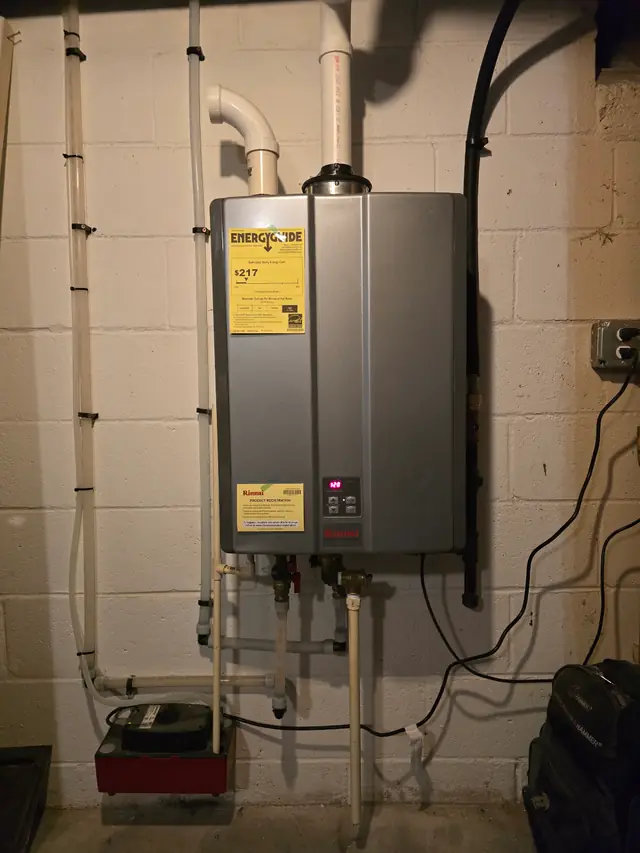
A tankless water heater removes that failure mode entirely, because there is no tank sitting full of water waiting to corrode. It heats water on demand as it passes through a heat exchanger, so there is nothing to rust out overnight and flood a basement. The tradeoff is that a tankless unit has its own requirements: correct gas line sizing for the burner it uses, proper venting, and periodic descaling in a house on hard water, since mineral buildup on the heat exchanger is the tankless equivalent of sediment in a tank. Karlsen Plumbing has installed Rinnai tankless units in basements across Southeast Wisconsin, and the swap is a common upgrade when an aging tank finally needs replacing.
What a Replacement Actually Involves
Swapping a water heater is not just unbolting the old one and setting a new one in its place. The water and gas or electric supply get shut off and disconnected, the old tank is drained and removed, venting is checked or replaced to match the new unit's requirements, and the connections go back together with dielectric unions, which keep two different metals from corroding each other where copper pipe meets a steel tank fitting. Once it is set, the system gets pressure tested and checked for leaks before anyone calls the job done.
Choosing Between Tank and Tankless
A tank is simpler, usually costs less up front, and heats water fast enough for most single family homes even when the tank is older and less efficient than it once was. A tankless unit takes up far less space, never runs out of hot water partway through a long shower, and sidesteps the corrosion failure a tank eventually has. The right call depends on the house: available gas line capacity, venting options, how the basement or utility space is laid out, and whether an old tank is being replaced on an emergency basis or as a planned upgrade. Neither option is automatically the right one for every basement.
A Real Number From a Real Job
One Racine homeowner, Mike Gibbs, wrote about having a new water heater installed along with two outside spigots and a repair to several broken supply line hangers, all in about three hours. In his own words, it was 'the best $2400 dollars I've spent on my house in a long time.' Every job is different and priced on what it actually needs, but it is a real figure from a real customer rather than a made up range.
If your water heater is showing any of the signs above, Karlsen Plumbing handles water heater repair and installation, tank or tankless, across Racine and Southeast Wisconsin, with 24 hour emergency service for when a tank does not wait for a convenient time to fail. Call (262) 633-1951, or see the plumbing service and repair page.
Karlsen Plumbing, Inc., (262) 633-1951
Call (262) 633-1951More articles
The Ten Minutes After a Pipe Bursts in a Racine Basement
A practical look at where cold-weather pipe failures start in Southeast Wisconsin homes, and how to limit the damage before help arrives.
How to Tell Your Sump Pump's Battery Backup Has Already Failed
What a battery backup actually does, why it tends to fail without warning, and how to check yours before the next power outage does.